
Dental Scam Watch
Misleading Dental Advertisements & Online Impersonation Scams
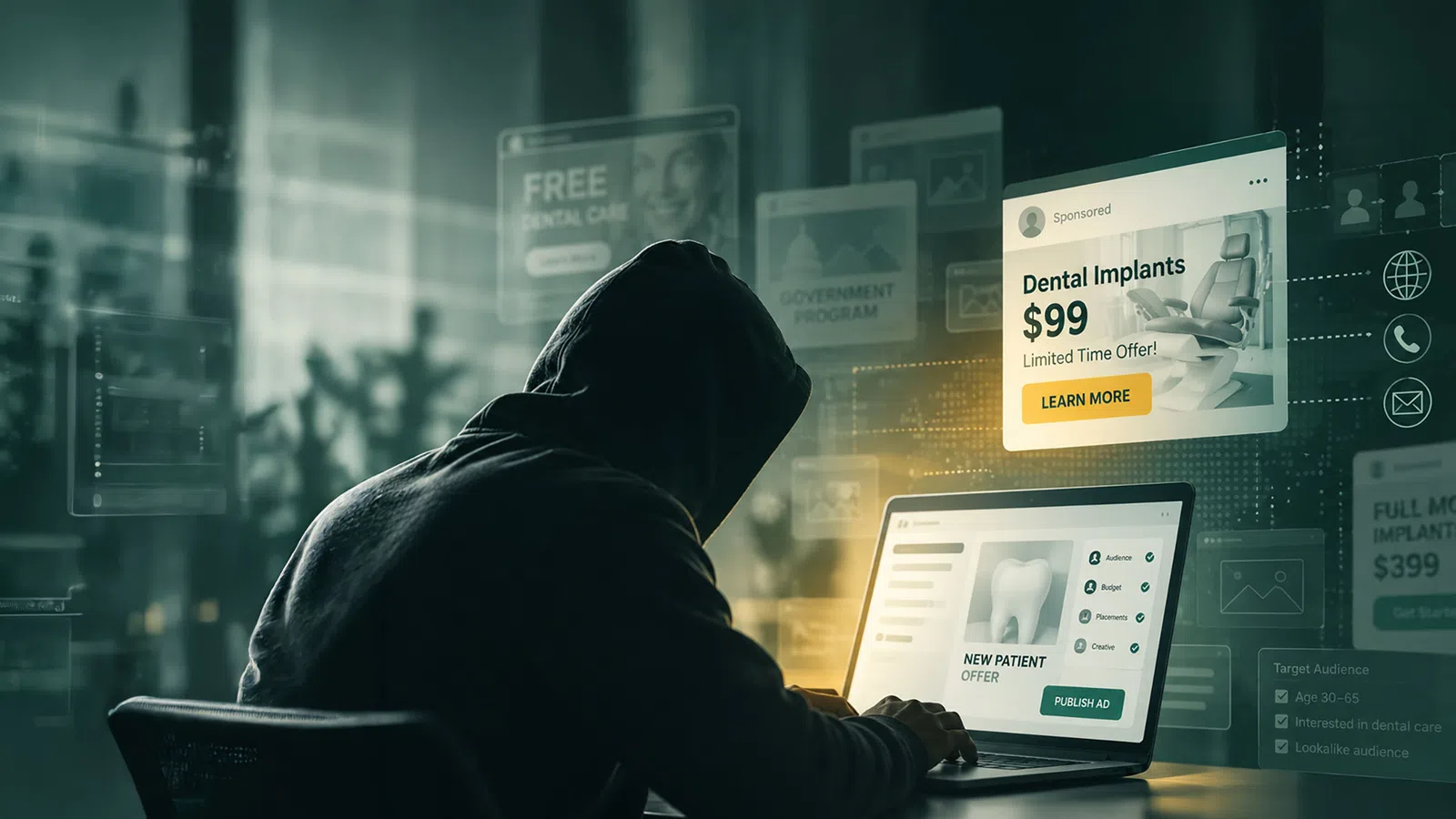
Unauthorized online ads sometimes borrow the identity of real dental practices to promote offers those practices never made. Many of these ads are designed to collect consumer data rather than deliver dental care. Recognizing the warning signs helps patients and practices respond before personal information changes hands.
An Overview
Misleading Dental Ads
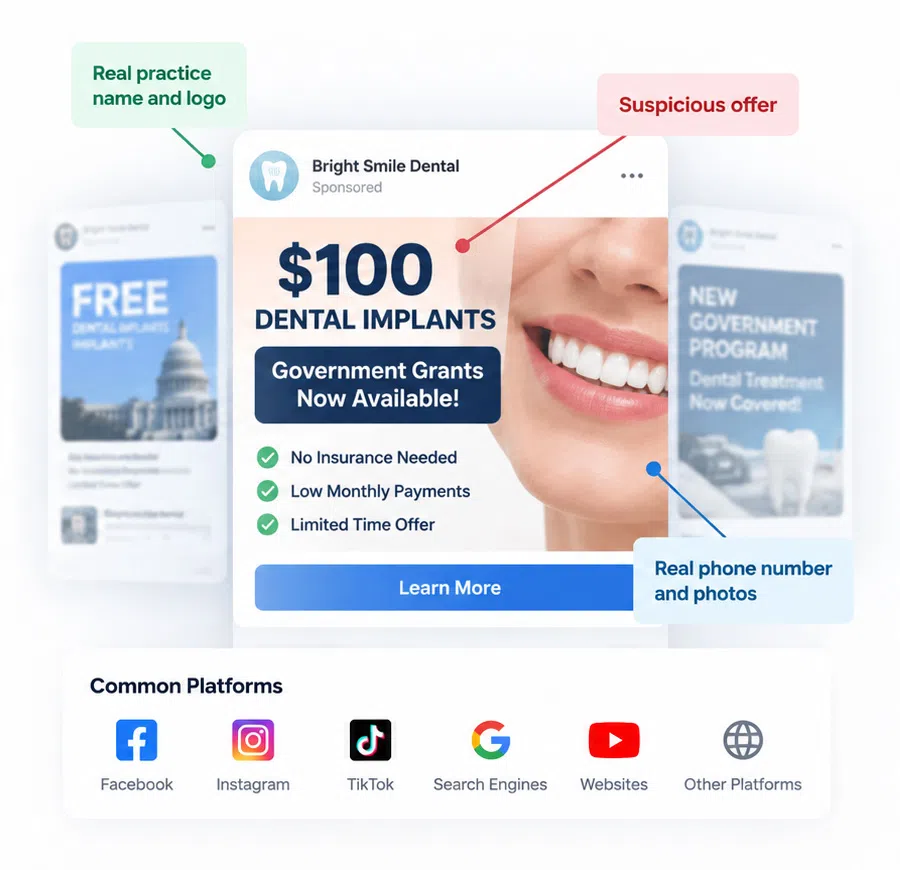
Patients and dental practices across the United States are encountering unauthorized online ads that promise things like:
- "$100 dental implants" or "Free dental implants"
- "Government grants for dental implants" or "New government programs" paying for dental treatment
- Extremely low monthly payment offers
- Free or heavily discounted cosmetic dentistry
These ads may appear on Facebook, Instagram, TikTok, search engines, and other websites. They may use legitimate dental practices' names, logos, phone numbers, photos, addresses, or doctors' identities without the practice's knowledge or permission.
These explanations represent a working hypothesis, not a proven account of every incident. The full business model behind these dental ads has not yet been established.
The Most Important Thing to Know As a Consumer
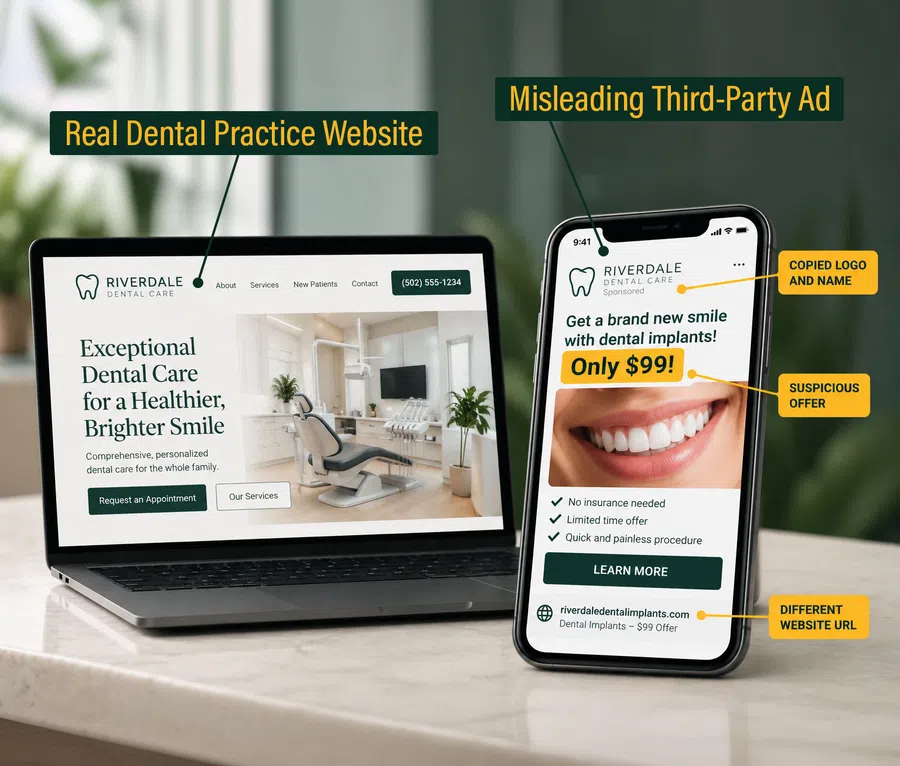
Seeing a dental practice's name, logo, or phone number in an ad does not mean the practice — or its legitimate marketing company — created the ad.
Third parties can copy publicly available business information and place it into an ad without permission. A copied logo, phone number, photo, or practice name proves only that the advertiser had access to information that was already public.
This is the same basic trust mechanism used in many phishing and impersonation schemes. A bad actor borrows the identity of a legitimate organization to make an unrelated communication appear trustworthy.
One example: ClearChoice Dental Implant Centers has publicly warned consumers about misleading third-party ads that falsely suggest ClearChoice offers extremely low-cost implants or dental implant grants. ClearChoice states that the ads are not created by or affiliated with ClearChoice and may redirect consumers to the real ClearChoice website.
For Patients: Understanding the Scam
Fake dental ads may exist to collect consumer data or generate leads. The real practice's phone number can serve as a disguise to lend the ad credibility. By the time a patient calls the office, the advertiser may already have the information it wanted.
Why would someone create a fake dental ad?
One likely explanation is deceptive lead generation or data harvesting.
When someone responds to an unusually attractive dental offer, the ad or associated webpage may ask for information such as:
- Name
- Telephone number
- Email address
- ZIP code or address
- Age
- Type of dental treatment needed
- Insurance information
- Financing needs
- Other demographic or treatment interest information
That information can itself have commercial value.
The Federal Trade Commission has extensively documented the online lead generation industry. In some lead generation systems, marketers collect consumer information and distribute or sell those consumers as prospective sales leads to other businesses. The FTC has described lead generation markets in which the consumer's personal data is effectively the product being exchanged.
In a 2025 healthcare-related enforcement action involving MediaAlpha, the FTC alleged that misleading social media, paid search, and other ads induced consumers seeking health insurance to provide personal information that was then sold to telemarketers. The FTC alleged that some ads falsely suggested government affiliation and promised low-cost comprehensive health coverage.
That does not prove that every misleading dental ad operates the same way. It does establish that the underlying business model — misleading healthcare advertising used to obtain and monetize consumer data — is real.
Why would a fake ad include the real dental practice's phone number?
At first glance, this seems counterintuitive. If someone is trying to harvest leads, why send the patient to the legitimate dental office?
One possible answer is that the eventual phone call is not the transaction the advertiser cares about.
The important event may have already occurred.
Modern digital advertising and call tracking systems can measure consumer behavior such as:
- Ad clicks
- Landing page visits
- Form submissions
- Treatment interest selections
- Geographic and device information
- Conversion events
- Calls initiated from ads or websites
- Call timing, duration, and other call activity
Meta openly offers advertising products designed to generate telephone leads. Google provides call reporting and website call conversion tracking for legitimate advertisers. Google states that call reporting can include details such as call start time, duration, connection status, and, in qualifying circumstances, the caller's phone number.
These are legitimate advertising tools. Their existence illustrates an important point: a consumer's call-related interaction can be measurable and valuable independently of where the eventual call terminates.
A Possible Sequence
- A consumer sees an ad displaying a legitimate dental practice's name or logo.
- The ad promotes an unusually attractive offer, such as "$100 implants" or a purported government grant.
- The consumer clicks the ad.
- The advertiser or associated technology records information about that interaction.
- The consumer may complete a form, answer treatment questions, provide contact information, or interact with a tracked calling mechanism.
- The consumer is ultimately directed to the real dental practice.
- The dental office receives a confused patient asking about an offer it never made.
By the time the patient reaches the dental office, the third party may already have obtained the information or advertising signal it was seeking.
Why is a legitimate marketing company an unlikely source of a fake ad?
A legitimate marketing company has almost no rational incentive to deliberately advertise an offer that its own client does not provide.
Imagine a marketing company intentionally advertising "$100 dental implants" for a practice that does not offer $100 implants. The predictable result would be:
- Angry or confused patients
- Extremely poor-quality leads
- Wasted staff time
- Damage to the practice's reputation
- Complaints against the marketing company
- Wasted advertising dollars
- Possible regulatory or legal exposure
- A damaged or terminated client relationship
That would be a remarkably self-defeating marketing strategy.
An unrelated third party may not care about any of those consequences. The dental practice's identity may simply be a credibility device if the advertiser's objective is to collect data, generate a marketable lead, obtain a trackable consumer interaction, or facilitate another form of fraud.
Can someone capture my phone number just because I click "Call"?
Not necessarily.
A simple click-to-call link does not automatically mean the advertiser receives the consumer's telephone number. The exact data available depends on the platform, call routing system, landing page, tracking technology, and how the campaign is configured.
However, advertising and call tracking systems can associate calls with campaigns and sessions, and some systems can expose additional call information. A malicious or deceptive funnel may also collect other information before a call is placed.
For that reason, the more accurate concern is not that every tap of a call button automatically reveals a phone number. It is that the consumer's interaction may already be trackable or commercially valuable before the call reaches the legitimate dental office.
For Patients: What To Do
A practice's name or logo in an ad does not prove the practice created it. Independent verification is the best defense against a suspicious dental offer. Patients should confirm promotions directly with the practice before sharing personal information.
They should also capture as much information as possible about the ad and share it with the practice. This helps practices preserve evidence and report unauthorized ads to the platform or to federal agencies.
What should a patient do?
If you encounter an unusually generous dental ad or a supposed government program:
- Verify the offer directly with the dental practice before providing personal information.
- Find the practice's official website independently rather than relying only on the link or phone number in the ad.
- Ask the office whether the promotion is legitimate.
- Take screenshots or a screen recording before closing the ad.
- Capture the advertiser/account name, offer, practice name/logo, landing page address, forms, and any phone or WhatsApp numbers.
- Do not provide Social Security numbers, banking information, credit card information, passwords, authentication codes, or other highly sensitive information unless you have independently verified who you are communicating with.
FTC consumer guidance similarly recommends contacting an organization through a phone number or website you know is legitimate rather than relying on contact information supplied in a suspicious message.
For Dentists: Verifying The Ad
Legitimate marketing providers keep records of the ads they run. When an ad doesn't appear anywhere in those records, an unauthorized third party is the likely source.
How should I respond when patients contact me about an ad?
Take the Patient Seriously
The fact that your office cannot locate the advertisement does not mean the patient did not see it.
Ask for a Screenshot or Screen Recording
If the ad is still visible, ask the patient to preserve it before closing the app or page.
Preserve Everything Available
- Screenshot or recording
- Platform
- Date and approximate time
- Advertiser or page name
- Landing page URL
- Phone number
- WhatsApp number
- Ad language
- Offer being promoted
- Forms the patient completed
- Information the patient submitted
Check Authorized Advertising Accounts
Confirm whether the ad exists in the practice's Meta, Google, TikTok, or other authorized advertising accounts. Ask all authorized marketing providers to do the same.
If the ad is absent from those systems and nobody approved the offer, that strongly supports the conclusion that the ad originated with an unauthorized third party.
Report the Ad or Impersonation
Depending on the platform and facts, reports may be appropriate for scam activity, business impersonation, trademark infringement, or other unauthorized use of the practice's identity.
Report Repeated or Serious Fraud
Potential fraud can be reported to the Federal Trade Commission at ReportFraud.ftc.gov. Internet-enabled fraud and impersonation can also be reported to the FBI Internet Crime Complaint Center at IC3.gov.
Why can't my dental practice find the ad?
Digital ads can be targeted based on geography, demographics, online behavior, language, device type, audience characteristics, and other factors.
That means the staff of the dental practice being impersonated may never receive the advertisement themselves. A patient can see the ad, call the office, and the practice may have no practical way to reproduce what the patient saw.
Ads, accounts, and landing pages can also disappear or change quickly.
A screenshot or screen recording from the patient is therefore extremely valuable.
Is my marketing company creating these ads?
If your practice did not approve the offer and cannot locate the ad in your authorized advertising accounts, it is highly unlikely that your marketing company created it. A legitimate marketing provider normally has records showing what it actually ran, including the advertising account, campaign, creative, copy, landing page, targeting, budget, billing, and conversion activity.
A third party does not need access to any of those systems to copy a practice's:
- Practice name and logo
- Phone number and address
- Doctors' names and photographs
- Website photographs and copy
- Reviews and services
- Other publicly available business information
For Dentists: Understanding Digital Threats
Are there potential threats to dental practices' Google Business Profiles?
Dental practices should also regularly verify the contact information displayed on their Google Business Profile.
Google allows claimed and verified Business Profiles in eligible regions to add WhatsApp or text messaging contact options. Google's documentation states that a business can add a WhatsApp click-to-chat URL or a phone number capable of receiving text messages.
If an unauthorized WhatsApp number or other messaging channel appears on a legitimate practice's profile, the risk can be more serious than a misleading ad.
How the Attack Could Work
- A patient searches Google for the dental office.
- The patient finds the legitimate dental practice's Business Profile.
- The patient clicks a WhatsApp or messaging option displayed on that profile.
- The messaging account is controlled by someone other than the practice.
- The third party impersonates the dental office.
A patient in that situation may reasonably believe they are speaking with the real practice because the communication originated from what appeared to be the practice's legitimate Google listing.
An attacker could potentially request:
- Personal information
- Insurance information
- Payment information or deposits
- Account credentials
- Authentication codes
- Other sensitive information
Unauthorized phone, WhatsApp, messaging, website, or appointment information on a Google Business Profile should be treated as a potential security and business impersonation incident — not merely an SEO or marketing problem.
Practices should regularly review phone numbers, WhatsApp information, text/SMS information, website URLs, appointment URLs, Business Profile owners, and Business Profile managers.
Could these schemes be related to phishing?
The underlying trust mechanism is similar.
The FTC explains that phishing scams often impersonate a company or organization the victim knows and trusts. Scammers may even use the real company's logo while attempting to obtain passwords, account numbers, Social Security numbers, or other personal and financial information.
Traditional phishing might look like:
Fake bank communication → real bank branding → fake login or request → victim provides information
A deceptive dental-data scheme could theoretically look like:
Fake dental advertisement → real practice branding → unusually attractive offer → consumer interacts or provides information
The exact objective may differ, but the psychological mechanism is similar: borrow the credibility of a legitimate organization to persuade someone to interact with something they would otherwise distrust.
Are these scams coming from overseas?
Possibly — but the operators behind these specific dental ads have not been conclusively identified.
Internet fraud routinely crosses national borders. U.S. government agencies have documented sophisticated phishing, impersonation, credential harvesting, and social engineering operations conducted by foreign actors.
In one 2023 joint cybersecurity advisory, U.S. agencies described North Korean Kimsuky actors directing victims to phishing sites that mimicked legitimate web portals and harvested usernames and passwords. In 2024, the FBI described North Korean actors conducting sophisticated social engineering campaigns and impersonating recruiters, technology companies, and known individuals.
These examples demonstrate that offshore phishing, impersonation, and data harvesting operations are real. They do not establish that Russia, North Korea, or any other particular country is responsible for misleading dental ads.
Why Offshore Involvement Remains a Reasonable Possibility
Characteristics frequently seen in these incidents can be consistent with operations that are easy to run remotely from anywhere in the world, including:
- Disposable social media accounts
- Rapidly changing ads
- Multiple languages
- WhatsApp-based communication
- Fake or altered business contact information
- Copied branding
- Difficulty identifying the actual advertiser
- Little apparent concern about the reputation of the business being impersonated
None of those characteristics proves that an operator is overseas.
A deceptive ad could be operated by domestic scammers, offshore scammers, freelance digital marketers, affiliate marketers, lead generators, data brokers, organized fraud groups, or multiple unrelated actors using similar tactics.
The advertiser, hosting provider, lead aggregator, data broker, telemarketer, and ultimate purchaser of a lead may also be located in different countries.
For that reason, offshore involvement should be described as a credible possibility and not an established attribution.
Could the same operators be behind the fake ads and the Google/WhatsApp incidents?
Possibly, but there is not enough public evidence to say.
Both schemes can rely on borrowing the credibility of a legitimate dental practice. However, misleading dental ads, deceptive lead generation, Google Business Profile manipulation, phishing, and direct business impersonation may involve different operators or different layers of a broader fraud ecosystem.
Until the operators are identified, these should be treated as potentially related but separately documented threats.
Be Part Of The Solution
Help Document These Ads
Suspicious dental ads can disappear quickly or appear only to specific audiences, making them difficult to investigate. If you encounter one, capture as much information as possible before closing it. Screenshots, URLs, contact details, and information about the advertised offer can help document the incident and identify connections between similar ads.
About This Project
Dental Scam Watch is an independent educational project documenting deceptive advertising, online business impersonation, suspected data-harvesting schemes, and other digital threats affecting dental practices and their patients.
Our work distinguishes between documented facts supported by reliable evidence, observed patterns reported by affected practices and patients, and working hypotheses that have not yet been conclusively proven.
Dental Scam Watch is not affiliated with Google, Meta, TikTok, ClearChoice, the Federal Trade Commission, the FBI, CISA, or any other organization cited on this site. References to these organizations are provided for educational purposes and source verification.
This website does not provide legal advice or determine whether any particular advertisement, business, individual, or organization has violated the law.
Frequently Asked Questions
Q Did my dentist create the "$100 implant" ad I saw?
Possibly not. If the office says it does not recognize the advertisement, its identity may have been used without authorization. Ask the practice directly whether the promotion is legitimate.
Q Did my dentist’s marketing company create it?
If the practice and its authorized marketing company never approved the offer and cannot locate the ad in their authorized advertising systems, it is highly unlikely that the marketing company created it. A third party can copy a practice's public logo, phone number, photos, and other information without accessing the practice's marketing accounts.
Q Is there a government program giving everyone free dental implants?
Be highly skeptical of broad advertisements making that claim. Legitimate government dental benefits vary by program and patient eligibility. An ad suggesting virtually anyone can receive a new government implant grant should be independently verified before providing personal information.
Q Why would scammers send me to a real dentist?
We do not know conclusively. One possibility is that the valuable interaction occurred before the call. If the consumer clicked an ad, visited a tracking page, completed a questionnaire, provided information, or generated another measurable event, the advertiser may already have obtained a commercially valuable lead or consumer signal. Sending the consumer to a real practice afterward can also make the experience appear more credible.
Q If I never provided a credit card, should I still be concerned?
Potentially. Names, phone numbers, email addresses, treatment interests, geographic information, and other consumer data can have commercial value. The FTC has brought numerous enforcement actions involving deceptive collection and distribution of consumer leads.
Q Why can’t the dental practice just find the ad?
Targeting can make an ad visible only to particular users, locations, languages, devices, or audiences. The ad may also disappear or change before the office can reproduce it.
Q What is the best evidence to preserve?
The best evidence is a screenshot or screen recording showing the full ad, advertiser/account name, offer, landing page URL, phone or WhatsApp number, and any forms or questions presented to the consumer.
Sources & Further Reading
Q Sources & Further Reading
- ClearChoice — Misleading Online Advertisements from Third Parties: https://www.clearchoice.com/legal/misleading-advertisements/
- Federal Trade Commission — Lead generation: When the "product" is personal data: https://www.ftc.gov/business-guidance/blog/2017/07/lead-generation-when-product-personal-data
- Federal Trade Commission — MediaAlpha healthcare lead-generation settlement discussion: https://www.ftc.gov/business-guidance/blog/2025/08/if-youre-deceiving-consumers-ftc-means-business-exploring-recent-settlement-mediaalpha
- Federal Trade Commission — Assurance IQ and MediaAlpha settlement announcement: https://www.ftc.gov/news-events/news/press-releases/2025/08/assurance-iq-mediaalpha-pay-total-145-million-settle-ftc-charges-they-misled-consumers-seeking
- Federal Trade Commission — How To Recognize and Avoid Phishing Scams: https://consumer.ftc.gov/articles/how-recognize-avoid-phishing-scams
- Federal Trade Commission — How To Avoid Imposter Scams: https://consumer.ftc.gov/features/how-avoid-imposter-scams
- Google Business Profile Help — Chat with customers from your Business Profile: https://support.google.com/business/answer/15013580?hl=en
- Google Business Profile Help — Add your phone number: https://support.google.com/business/answer/16750496?hl=en
- Google Ads Help — About call reporting: https://support.google.com/google-ads/answer/2454052?hl=en
- Google Ads Help — Track calls to a phone number on your website: https://support.google.com/google-ads/answer/6095883?hl=en
- Meta — Lead ads with calling: https://www.facebook.com/business/ads/ad-objectives/lead-generation/lead-ads-with-calling
- CISA — Understanding and Mitigating Russian State-Sponsored Cyber Threats: https://www.cisa.gov/news-events/alerts/2022/01/11/understanding-and-mitigating-russian-state-sponsored-cyber-threats-us-critical-infrastructure
- FBI IC3 — North Korea Aggressively Targeting Crypto Industry with Well-Disguised Social Engineering Attacks: https://www.ic3.gov/PSA/2024/PSA240903
- FBI/NSA/State Department — North Korean Actors Exploit Weak DMARC Security Policies to Mask Spearphishing Efforts: https://www.fbi.gov/file-repository/cyber-alerts/north-korean-actors-exploit-weak-dmarc-security-policies-to-mask-spearphishing-efforts-050224.pdf
- FBI/CISA/NSA et al. — 2023 Joint Cybersecurity Advisory on North Korean Kimsuky activity: https://www.ic3.gov/CSA/2023/230601.pdf
- FBI Internet Crime Complaint Center: https://www.ic3.gov/
- FTC Fraud Reporting: https://reportfraud.ftc.gov/